Be yourself; Everyone else is already taken.
— Oscar Wilde.
This is the first post on my new blog. I’m just getting this new blog going, so stay tuned for more. Subscribe below to get notified when I post new updates.
Be yourself; Everyone else is already taken.
— Oscar Wilde.
This is the first post on my new blog. I’m just getting this new blog going, so stay tuned for more. Subscribe below to get notified when I post new updates.
In last week’s blog on regulations, we explore the idea of how the sustainable development goals set by the united nations are also inter-connected and that the strategies for achieving these goals will be overlapped with one another.
This week, we will look at the aspect of social innovation and how it can be used to tackle the many issues we face as a society when it comes to wastewater treatment. But firstly, what do we even mean by social innovation?
Put it simply, social innovations are new social practices that aim to meet social needs in a better way than the existing conditions. It is the process of developing and deploying effective solutions to challenging and often systematic social and environmental issues in support of social progress.
There have been numerous startups over the past few years through which several humanitarian projects. A startup usually begins with a campaign which makes a pitch to generate investment through crowdfunding. Population funding platforms such as Gofundme,
Indiegogo and Startsomegood have gained strong attention over the years thanks to social media.
As I illustrated in last week’s blog, people have a “couldn’t care less” attitude when it comes to wastewater. We know it’s important but we just can’t be bothered doing anything about it!
But what if we delivered powerful messages for wastewater through people who had a strong influence?
Let’s wind the clock a bit to last year for the WA tourism sector. Swiss tennis legend Roger Federer visited our very own Rottnest Island and took a selfie with a Quokka. On social media, this selfie got more than 540,000 likes and a short time after his visit, Rottnest Island has had the highest numbers of visitors on record over a given year.

Now you might be wondering what any of this has to do with social innovation?
We have to first realise that things are being done differently today more than ever before. Jobs are being searched on places like LinkedIn, not the newspaper. To look up a business, you’d google or go through reviews on Yelp, not the Yellow pages. To find out the great events that are happening near you, we will check out Facebook or Eventbrite, not as much the posters on community noticeboards.
The way we engage with one another is changing dramatically, and utilising social media platforms is vital for creating long lasting change when it comes to wastewater.
A real-life example that really helps illustrate this point is the case of Thankyou, an Australian social enterprise. This company donates funds to safe water, hygiene, sanitation programs and food security programs in 16 countries. This is done through the sales of its water, body care and food products.
But it was far from smooth sailing for this social enterprise. It took them 5 years before both major supermarkets Coles and Woolworths agreed to put their products on their shelves.
The turning point? A launch campaign driven by the public targeted towards Coles and Woolworths’ Facebook pages.
Thousands of Australians posted footages of themselves urging the supermarket giants to stock Thankyou products.
It is clear that a huge market is available for environmentally friendly products and causes with people becoming more aware of their environmental impact.
The agenda for addressing sustainable development goal 3 of clean water and sanitisation can be achieved through social media on local, national and global scales.
Coming back to Roger Federer’s magic when it came to Rottnest Island, we can see that the messenger is as important as the message itself. For social media to really prove its value, we need advocates that have a strong social influence.
Fortunately, we have celebrities in this world who do some good besides living the high life. One of these Matt Damon. In 2009, Matt Damon founded Water.org, this is a microfinance organisation that enables families in developing countries to build clean water and sanitisation systems.
Another great example comes from the well-known celebrity Kendell Jenner, the well known American model and media personality. With over 28 million followers on Twitter and another 115 million followers on instagram, Jenner holds a HUGE social influence with her large audience base.
Thankfully, it has not been wasted on just self-marketing. She is a key advocate of Charity Water, another non-profit organisation bringing clean and safe drinking water to people in developing countries. Since humble beginnings in 2006, this group has funded over 38,000 water projects globally predominantly in Africa and India.
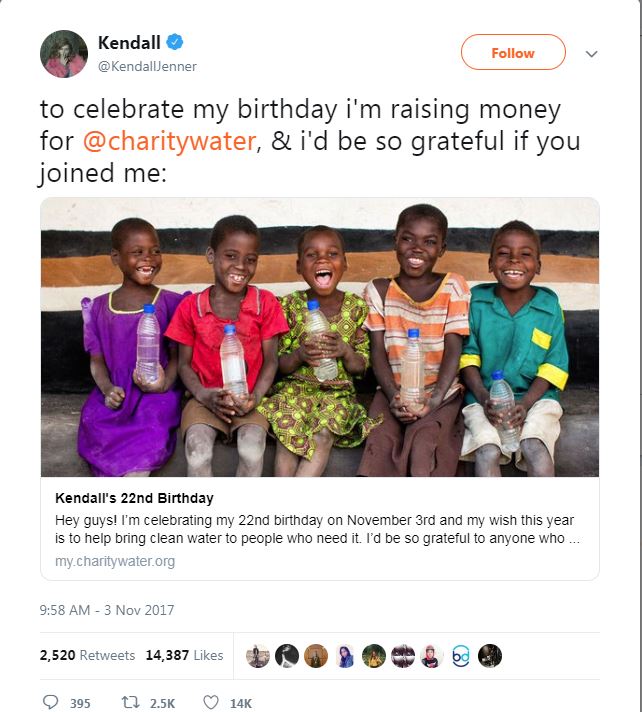
This non for profit is really transparent about the progress of their projects. You can even get access to their project database of all their remote sensors for clean water measurements over here:
https://www.charitywater.org/our-projects/completed-projects/
From both of the examples of Thankyou water and widely followed celebrities such as Matt Damon and Kendall Jenner, we can see the immense power that social media has in bringing awareness to important issues that face many in today’s society.
When people use their powerful platforms to create positive change, whilst not guaranteeing change, it certainly begins to pave the way for action to be taken towards the sustainable development goals. The examples we have seen have shown how the goal of clean water and sanitisation can be achieved. However, celebrities such as Leonardo Di Caprio have also championed their cause for climate change for several years including a time at an oscar winning speech for The Revenant, something that can’t be overlooked for actions towards the goal of climate change.
References
Over the past few weeks, we have investigated the issues of wastewater in our society. Beginning with the constituents of wastewater, we have explored how we can improve our wastewater infrastructure in the future through means of smart solutions and social innovation.
We have identified the problems that are facing the water industry and we have also come up with some feasible solutions. But, we should all know very well by now that change in this world is something that never happens overnight!
Many times, this is because of the presence of legislation and regulations framework. If you want to do something, you’ve got to be willing to work around the red tape.
Regulations are vital for a functioning society; however, they have both perks and perils. Without them, people could just do whatever they wanted without caring for how their actions affect people around them. However, whilst sometimes regulations can be the biggest hurdles for us to create positive change, changing people’s attitudes can be far more difficult.
As consumers we set the standard pretty high for our drinking water, at the end of the day it’s our most frequently consumed liquid and we like to make sure it is clean. So despite, councils having regulations and guidelines for discharging wastewater, some of the major reasons for the lack of advancement in water recycling has been due to public reluctance in using recycled water.
One of the areas of human psychology is the contagion heuristic, which is a thinking mentality that leads people to avoid contact with people or objects viewed as “contaminated” by previous contact.
Another problem is the lack of education or to an extent the ignorance amongst many in society towards the understanding of where their water comes from or goes to.
A survey was conducted in Oregon State University back in 2008, where only 13% of participants accepted the use of recycled wastewater for human contact or consumption. But when asked about industrial, irrigation or municipal uses, the acceptance response rate rose to a staggering 55%.
For a slightly more local example, during the millennium drought of 2006, the town of Toowoomba voted against a wastewater recycling scheme. However, despite public reluctance, then Queensland premier Peter Beattie approved the construction of one of the world’s biggest water recycling at a cost of $2.5 billion.
Was it a success? Absolutely not!
Despite the infrastructure being built, the water has never been released into the city’s drinking supply. In 2009, under then Queensland premier Anna Bligh, it was decided that the water would not be used from this scheme until dam levels fell to below 40 per cent.
It seems that even talking about drinking recycled water has become a political taboo. Currently, NSW is experiencing the worst drought in history and despite this, water recycling is being discouraged. The Independent Pricing and Regulatory Tribunal (IPART) has imposed a surcharge to increase the cost of installing water recycling systems in urban areas connecting to Sydney Water’s infrastructure.
Regions around the world such as California, Singapore and Namibia seemed to have a much wider acceptance for drinking recycled wastewater. The process is commonly known as “toilet to tap”. Furthermore, whilst California legislation supports the consumption of recycled water, the biggest driver that creates an acceptance for doing so amongst the wider community is the education amongst residents of the process that goes behind the treatment of wastewater.
On National Public Radio (NPR) from the link below, one of the few opponents of drinking recycled water admits saying “It’s pretty gross. I would feel like before I drink it, I’d want to really know how they purify and stuff.”
Here in Perth, we are actually leading the way as far as waste water treatment goes. The Water Corporation established a visitor centre where thousands of outreach school programs were undertaken. School children along with their parents come to the visitor centre to underthe wastewater treatment process, the technology behind it and its risks.
This is reflected in another survey that was conducted by the Water Corporation in 2012 where 79% of Perth residents were in support of the wastewater recycling scheme.
Another big driver in creating change for wastewater results from the circumstances that presented to a respective community. For regions like Texas and California, the residents had no choice but to go with the wastewater recycling due to the severe drought in 2014/2015.
So how do we get people to accept them? What makes Perth, Singapore, Texas and California stand out from the rest when it comes to wastewater?
When faced with no other alternative, it is human nature to simply go with the flow and accept the current trend as the right path. Perth on the hand, whilst fortunately has not experienced a drought recently, strategies from the Water Corporation have come a long way to building strong dialogue with residents on the process of recycling wastewater.
We can see that wastewater regulations have to be tacked in conjunction with wastewater education. So, for the objectives of the united nation’s sustainable development goals, perhaps SDG 13 can be made broader to educate not just youth but also the broader community about climate change as well as urban wastewater treatment. The United Nation’s sustainable development goals cannot be made so discrete because these goals are interconnected and strategies for tackling one goal can be incorporated into another. SDG 6 of achieving clean water and sanitation will still require actions to be taken towards SDG 13 and vice versa.
References
https://www.abc.net.au/news/2018-03-19/drinking-recycled-water/9546900
Sustainable Development Goal 9 set by the United Nations is to build resilient infrastructure, promote inclusive and sustainable industrialisation and foster innovation. When it comes to dealing with wastewater treatment for future generations and meeting their demands, society needs to pause and re-evaluate our current methodology for dealing with wastewater. But just like everything in life, if we are talking about changing the world’s current way of doing things, it’s a good idea to narrow things down to get the finer details.
In this blog, we are going to focus on the current wastewater treatment system of Perth in Western Australia. The Water Corporation is the principal supplier of water, wastewater and drainage services throughout the state of Western Australia.
The major wastewater treatment plants owned by the Water Corporation are in Alkimos, Beenyup, Subiaco, Woodman Point and East Rockingham. However, when we look at the location of these plants in comparison to the sheer size of Perth, it is a classic example of a centralised system. People’s awareness is not only driven by knowledge and education but also their environment and surroundings.
When looking at the population demographics, it is clear that majority of Perth’s urban population does not live in the proximity of a wastewater treatment facility. As a result, many residents will continue with their daily water usage practices without thinking of it’s consequences.
Future Challenges Of Wastewater
A decentralised system does not come with any perils. Having a larger number of wastewater treatment plants that are more evenly distributed through Perth will present some significant challenges when implemented.
Firstly, energy consumption is a major obstacle in running a wastewater treatment plant. The smaller a plant, the higher it’s specific power consumption.
From an operational point of view, a wastewater treatment facility is very demanding as staff are on operation 24 hours a day with major responsibilities of overseeing valves and leeks in the system. With a high number of plants in place, there is a greater demand for staff and whilst this can be viewed as a growth in jobs, it is nonetheless an increase in cost.
One of the biggest issues will be lack of land availability as with population growth, residential and commercial developments will be increased accordingly. Therefore, smart urban planning will be vital for the construction of addition wastewater plants.
Sludge production is another significant challenge that is facing the water industry. With sludge being a bi-product of wastewater treatment, sludge plants are very costly to construct and require large areas of land. Now you might think that this shouldn’t be a problem because we are in Australia and we have a lot of land. However, we can’t forget about the future population size which will require municipal wastewater treatment plants to increase their land requirements as well.
Future Wastewater Treatment Demands
By 2050, cities like Sydney and Melbourne will become the size of current London. As a result, the demand for water usage will increase rapidly and our wastewater infrastructure will need to be upgraded to meet these demands. But for a sustainable city, smart thinking has to come from both ways, the government as well as the people. Sure, money could be poured in to build more and technologically advanced wastewater plants, but what are we doing from our part?
Rainwater tanks will need to become a crucial aspect of households in the future, and by doing so residents reduce their dependency on the mains water supply. The maintenance and construction of dams and reservoirs comes at a huge cost and their expansion will be at the expense of future taxpayers such as you and I. The less reliant we are on the mains water supply; the less facilities will need to be expanded.

The impact of storm water runoff is also significantly reduced when increase use from rainwater tanks. As a society we also become more independent as water restrictions don’t end up having a severe impact on households as rainwater tanks provide an alternative supply.
So, overall how does tacking the future challenges for wastewater treatment contribute towards the goal set by the UN? The most effective way to reduce the risk of our current infrastructure lacking capacity to meet future generation’s demands is to reduce our dependencies and become more self-sufficient. Whilst rainwater tanks are not the complete solution, they are an important step towards creating sustainable infrastructure that is resilient and incorporates sound innovation.
References
https://www.oxymem.com/blog/4-major-operational-challenges-facing-wastewater-treatment-plants
In 2015, the United Nations adopted 17 Sustainable Development Goals. One of these goals in particular is to ensure availability and sustainable management of water and sanitation for all. But before we try and do something about this, we need to understand one particular aspect of what gives rise to the lack of sanitized water for many countries in the first place, which is the composition of our wastewater that we release into the environment.
Being the most important resource for a functioning civilization, it is vital that we understand the nature and characteristics of wastewater for its effective treatment and management.
Let’s begin this discussion by pointing out that all of us play a role in the constituents of wastewater because all of us use water constantly, cooking, cleaning, personal hygiene, we couldn’t live without it.
Human waste such as urine and excretion are the biggest contributors to the constituents of wastewater as far as “natural waste” is concerned.
Commercial and pharmaceutical consumptions are also a major factor in the issue of wastewater. Toothpaste, shampoo, conditioners, dish soap, medicines, vitamins and the list goes on. These constituents from your household are transported to the main council plumbing to the wastewater treatment plant.
Some of the major types of constituents that occur in wastewater are as follows:
However, in this blog I am going to focus on the issue of heavy metals being discharged into our wastewater. In order for society to become more mindful about what goes into our wastewater, it is crucial that we understand how pollution in the wastewater affects our health and lifestyle.
Let’s face it, what will be the bigger incentive for us to actually do something about our wastewater, it’s impact on our environment or our health?
With the number of developed nations increasing, heavy commercial and industrial activities have been a contributing factor to the presence of heavy metals in wastewater. In large quantities, metals such as lead, mercury, arsenic and cadmium are the most toxic heavy metals and when present in wastewater, they present a large risk to the environment, animals and humans. These heavy metals can also contaminate drinking and land irrigation water.
As far as the impact of heavy metals in wastewater is concerned, there is extensive evidence which shows that species of fish such as tuna and swordfish contain the highest levels of mercury. These levels can prove fatal to the human immune system in the long term if consumption of these species is not done in moderation.

Source: https://globalseafoods.com/blogs/news/low-mercury-seafood
So how do mercury and other heavy metals end up in our marine ecosystems in the first place?
Ok, I’ll admit that we are not the only reason for heavy metals ending up in our marine ecosystems. Heavy metals are also introduced into water through weathering and erosion of soils and rocks as well as from volcanic eruptions.
However, the most common heavy metal pollution in freshwater comes from industrial and mining operations, giving rise to toxic conditions for marine organisms in their natural environment. More information on this link below.
https://www.lenntech.com/aquatic/metals.htm
But when dealing with the issue of wastewater treatment, we also have to approach it from a perspective of population growth into the future. As populations in cities increases, the level of industrial activity increases proportionally to meet our demands and services. Hence, the concentrations of heavy metals in water will also increase in addition to the amount of pollutants and harmful substances present in the water.
Heavy metals in our wastewater is bad for the environment AND for us. What can we do about it?
One of the most effective ways of removing heavy metals from wastewater is through a process known as Ion Exchange. From basic high school chemistry, we know that there are two types of ions, cations (positively charged) and anions (negatively charged).
This process occurs between a substance known as a resin (in solid form) and a liquid such as wastewater. Essentially, positively charged cations are exchanged with the resin’s cations on the surface., vice versa for the anions. In most ion exchange processes, sodium is used for the cations on the resin’s surface while chloride takes the place of anions. Further information is available from this link below:
https://pdfs.semanticscholar.org/428f/d34c37f3b95900d80119e5726d3e17a73ace.pdf

We can see that what goes into our wastewater has a huge impact on the quality of water in our marine ecosystems and urban water bodies. When looking at the bigger picture of wastewater, heavy metals are only part of the problem and ion exchange is only part of the solution. Many developing nations do not have the sufficient infrastructure and facilities to undertake wastewater treatment processes such as Ion Exchange. Investigation of new and innovative methods must be encouraged and pushed for by public and private sectors around the world for us to achieve our sustainable development goal of clean water and sanitization for all.
This is an example post, originally published as part of Blogging University. Enroll in one of our ten programs, and start your blog right.
You’re going to publish a post today. Don’t worry about how your blog looks. Don’t worry if you haven’t given it a name yet, or you’re feeling overwhelmed. Just click the “New Post” button, and tell us why you’re here.
Why do this?
The post can be short or long, a personal intro to your life or a bloggy mission statement, a manifesto for the future or a simple outline of your the types of things you hope to publish.
To help you get started, here are a few questions:
You’re not locked into any of this; one of the wonderful things about blogs is how they constantly evolve as we learn, grow, and interact with one another — but it’s good to know where and why you started, and articulating your goals may just give you a few other post ideas.
Can’t think how to get started? Just write the first thing that pops into your head. Anne Lamott, author of a book on writing we love, says that you need to give yourself permission to write a “crappy first draft”. Anne makes a great point — just start writing, and worry about editing it later.
When you’re ready to publish, give your post three to five tags that describe your blog’s focus — writing, photography, fiction, parenting, food, cars, movies, sports, whatever. These tags will help others who care about your topics find you in the Reader. Make sure one of the tags is “zerotohero,” so other new bloggers can find you, too.

 The Water Police